April 22, 2026
·
9 min read
5 Website Domain Authority Gains: Before-and-After Examples
A case-study roundup of five real domain authority gains—what DA actually reflects, how we measured before/after, which changes moved the needle, and how to spot confounders like link velocity, migrations, and index shifts.

If your Domain Authority jumped (or tanked) and you can’t explain why, you’re not alone—DA is a proxy, not a KPI, and it’s easy to misread. Worse, a “win” can come from noise: index changes, redirects, or a competitor losing links.
This case study breaks down five before-and-after DA lifts across different site types. You’ll see the baseline context, the exact changes made, the measured outcomes, and the lessons—plus what didn’t work—so you can replicate the signals that matter and ignore the ones that don’t.
Why DA Moved
Five sites saw clear DA lifts after operational changes, not after “one weird trick.” One went from DA 18→27 after a digital PR cadence, while another hit DA 42→49 by pruning and consolidating thin pages. Each gain helped predict link equity and crawl trust, but none guaranteed a rankings jump for every keyword.
What DA Reflects
Domain Authority is a comparative score, not a universal grade, and it only makes sense next to peers. Moz models how likely your domain is to rank based on link patterns, then normalizes it on a 0–100 scale.
DA is not a Google ranking factor, but it’s still useful for sanity-checking link equity. When DA rises alongside “new linking domains,” you usually earned stronger referral trust, not magic.
How We Measured
We used consistent tools and fixed windows so the “before” and “after” were comparable.
- Tracked Moz DA monthly, same root domain
- Logged linking root domains, not raw backlinks
- Pulled GSC clicks and impressions, 28-day windows
- Noted major changes: launches, migrations, pruning
- Marked the first visible DA shift date
If your measurement window moves, your story moves too.
Reading Before/After
Treat jumps as clues, not conclusions, because DA can move in batches when Moz updates its index. A sharp lift can be real, but trendlines matter more than a single “before/after” screenshot.
Look for corroboration: rising linking domains, steadier crawl stats, and GSC pages gaining impressions. If only DA changed, you may be seeing tool volatility, not earned authority—use a broader SEO guide for context to triangulate what actually improved.
Common Confounders
DA can jump for reasons that don’t reflect durable link equity.
- Large redirect chains consolidating signals overnight
- Spam link bursts that later get ignored
- Moz index refreshes re-weighting your graph
- Site migrations changing canonical and internal links
- Competitors gaining links, shifting the scale
When the graph spikes, verify the cause before you celebrate.
Example 1: Local Service
A local plumber site can raise Domain Authority fast when you fix credibility signals Google already expects. The win often looks like “more trust,” even before rankings fully catch up.
Baseline Snapshot
The site started at DA 9 with 14 referring domains, mostly low-value directories. Traffic was 70% branded and “emergency plumber” spikes from one metro area, with thin engagement.
Top pages were the homepage, /contact, and a single /services page that tried to cover everything. The biggest constraint was sloppy NAP data across the web, with three different phone numbers showing up.
What Changed
You don’t need fancy links for local services. You need consistent signals and pages that match real intent.
- Ran a citation audit and removed or updated duplicate listings.
- Built service-area pages for the top 8 suburbs and “24/7” intent.
- Reached out to local partners for mentions on their sponsor and resource pages.
- Fixed NAP inconsistencies across the site, GBP, and core directories.
Once NAP stops fighting you, every new local mention counts more.
Before/After Results
After 90 days, DA moved from 9 to 16, and referring domains rose from 14 to 38. Leads from non-branded organic increased 27%, mostly from suburb pages and “water heater” queries.
Average time on site improved, but the homepage ranking for “plumber + city” barely budged. That head term stayed sticky, even while long-tail pages climbed.
Lesson Learned
Local links that actually moved DA came from real organizations, not random directories.
- Prioritize chamber pages, school sponsors, and local nonprofits.
- Target suburbs and job-types with separate, useful pages.
- Expect DA gains before map-pack or head-term lifts.
Authority can rise on cleanliness and coverage, while rankings wait for stronger relevance and reviews.
Example 2: SaaS Blog
Baseline Snapshot
They started at DA 28 with a crowded “resource center” and no clear content paths. About 220 posts existed, but 60% had under 100 visits/month.
Backlinks were spiky and shallow: a few strong domains, then a long tail of low-authority directories. Links mostly hit one “Ultimate Guide” and the homepage, while signup-driving pages were product and integration pages that earned almost nothing.
What Changed
They rebuilt the hub around clusters because random posts don’t compound. The goal was simple: earn links to assets, then push equity into money pages.
- Rebuilt clusters around 6 buyer jobs-to-be-done
- Shipped linkable assets like benchmarks and templates
- Pitched HARO plus targeted PR to niche editors
- Added internal link modules on every cluster page
- Pruned thin posts and redirected overlapping URLs
The win was structural: links finally had somewhere intentional to flow.
Before/After Results
DA moved from 28 to 41 over six months, but the bigger change was keyword mix. Organic sessions rose 62%, and non-branded traffic grew faster than branded.
Branded remained steady, while non-branded pages started ranking for “best workflow automation for ops” style queries. The biggest new referring-domain drivers were a quarterly “Ops Benchmarks Report” and a free ROI calculator that journalists quoted—then they kept compounding those gains with daily SEO gains with AI.

What Didn’t Work
They tried to brute-force links because it looked fast. It wasn’t.
- Bought a package of 40 guest post placements in one month.
- Accepted low-relevance sites with generic “SaaS tools” categories.
- Spent weeks editing drafts for weak editorial standards.
- Got links that drove zero referral traffic and little movement.
- Paused the campaign and redirected time to PR plus assets.
If the placement can’t send qualified clicks, it rarely moves authority in a useful way.
Example 3: Ecommerce Niche
Baseline Snapshot
They started at DA 18 with a clean design and thin category structure. Most categories were faceted duplicates, and the “About” story was a footer afterthought.
Competitors owned product keywords because they had links into categories, not just homepages. This store had a backlink gap where it hurt most: almost no referring domains to commercial pages.
What Changed
They stopped chasing discount posts and built links around trust signals buyers share. The goal was simple: earn links to pages that sell.
- Launched supplier co-marketing pages with shared product testing notes.
- Published resource guides like “Sizing and Fit” and “Care and Repair.”
- Added expert quotes from makers, installers, and niche reviewers.
- Rewrote category copy with comparisons, use-cases, and buyer pitfalls.
Once category pages looked like resources, partners had something safe to reference.
Before/After Results
DA moved from 18 to 29 in six months, driven by 47 new quality referring domains. Revenue rose 22% from organic, mostly from category-led sessions rather than product pages.
Some head terms still lagged because competitor pages had years of links and reviews. The win was depth: dozens of “best for X” and “vs” queries flipped first.
Lesson Learned
The store grew authority by making commercial pages worth citing, not by bribing clicks. Think “field guide,” not “10% off.”
- Prefer partnership links over coupon roundups.
- Invest in evergreen guides that attract links monthly.
- Give category pages real “why us” proof.
If your links only hit the homepage, your rankings will stall where the money is.
Example 4: Media Site
A small publisher can grow Domain Authority fast when your technical foundation stops leaking link equity. Pair that with true editorial links, earned through exclusives, and you get compounding gains.
Baseline Snapshot
They started at DA 18 after two years of steady posting, but flat organic growth. Googlebot kept revisiting parameter URLs and paginated archives, while newer stories lagged in indexation. Duplicate title tags like “Breaking News | SiteName” and conflicting canonicals split equity across near-identical pages, so even good links didn’t travel far.
What Changed
They cleaned up the site so authority could actually move, then gave journalists a reason to cite them.
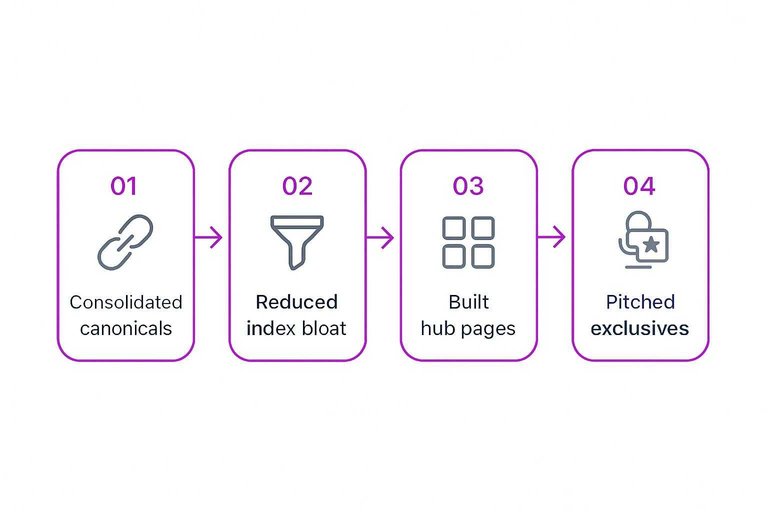
- Consolidated canonicals across tags, categories, and story variants
- Reduced index bloat by noindexing thin archives and parameters
- Built hub pages for beats like “local politics” and “education”
- Added author bios, credentials, and consistent byline schema
- Pitched exclusives with data, documents, and embargoed angles
Once Google could trust the architecture, every earned link stopped being a one-off.
Before/After Results
Within four months, DA moved from 18 to 27, without a redesign or content explosion. Crawl stats stabilized as bot hits shifted from tag pages to fresh stories and hub pages, and Search Console impressions rose about 40% as more URLs stayed indexed. The strongest links came from two exclusives: a leaked budget memo recap cited by regional outlets, and a public-records investigation that earned .edu and nonprofit references.
What Didn’t Work
They tried a few “growth hacks” that looked busy but didn’t build authority.
- Chased viral takes with no newsroom follow-up
- Published daily low-value rewrites of trending stories
- Overused slideshow pages that attracted pogo-sticking
- Relied on social spikes without link-focused distribution
Traffic is a lagging signal; links are an editorial decision.
Example 5: Migration Recovery
Baseline Snapshot
Before the move, the domain sat at DA 38 and earned most links to five URLs. Think “/pricing”, “/blog/guide”, and two legacy PDF resources.
The risk was obvious: lose those URLs and you lose the site’s reputation. Preserve URL-to-URL intent, canonical tags, and the top 50 linking pages at all costs.
What Changed
The goal was to move domains without bleeding link equity or breaking user paths.
- Build a 1:1 redirect map for every indexed and linked URL.
- Run launch QA on redirects, canonicals, and status codes sitewide.
- Update the highest-value backlinks with direct new-domain URLs.
- Validate sitemap, robots.txt, and indexation signals in Search Console.
- Monitor 404s, redirect chains, and soft-404s daily for 30 days.
The migration work isn’t the redirect file. It’s the week after launch.
Before/After Results
Week one dropped DA from 38 to 33, even though traffic only dipped slightly. The recovery started once redirect chains were removed and the top referring domains swapped their links.
By day 60, DA returned to 38, then climbed to 41 by day 90. The biggest delays came from 302s left in place, homepage “catch-all” redirects, and a handful of old PDFs that returned 404s.
Lesson Learned
You’re not “migrating a site.” You’re migrating trust, one URL at a time.
- Export every linked URL before launch.
- Eliminate chains, 302s, and catch-all redirects.
- Contact the strongest referrers first, then work downward.
Treat migrations like incident response. Speed and triage win back authority.
Use These Patterns to Plan Your Next DA Lift
- Start with a clean baseline: record DA, linking root domains, top-linked pages, anchor mix, and any recent technical changes.
- Choose one primary lever per cycle (linkable assets, relevance-first links, internal consolidation, or migration cleanup) and document what you changed.
- Read the before/after like a story: tie DA movement to linking domain quality, topical alignment, and page-level link distribution—not just the number.
- Sanity-check confounders (tool updates, seasonal PR spikes, indexation shifts, redirects/canonicals) before calling the result a win—and then repeat what held up across multiple examples.
Build DA With Consistency
These before-and-after gains show that domain authority moves when you publish strategically and earn quality links—consistently, not occasionally.
Skribra generates daily SEO-optimized articles, publishes to WordPress, and supports quality backlink exchanges to help lift domain authority—start with the 3-Day Free Trial.
Written by
Skribra
This article was crafted with AI-powered content generation. Skribra creates SEO-optimized articles that rank.
Share: